Seven Centuries of History
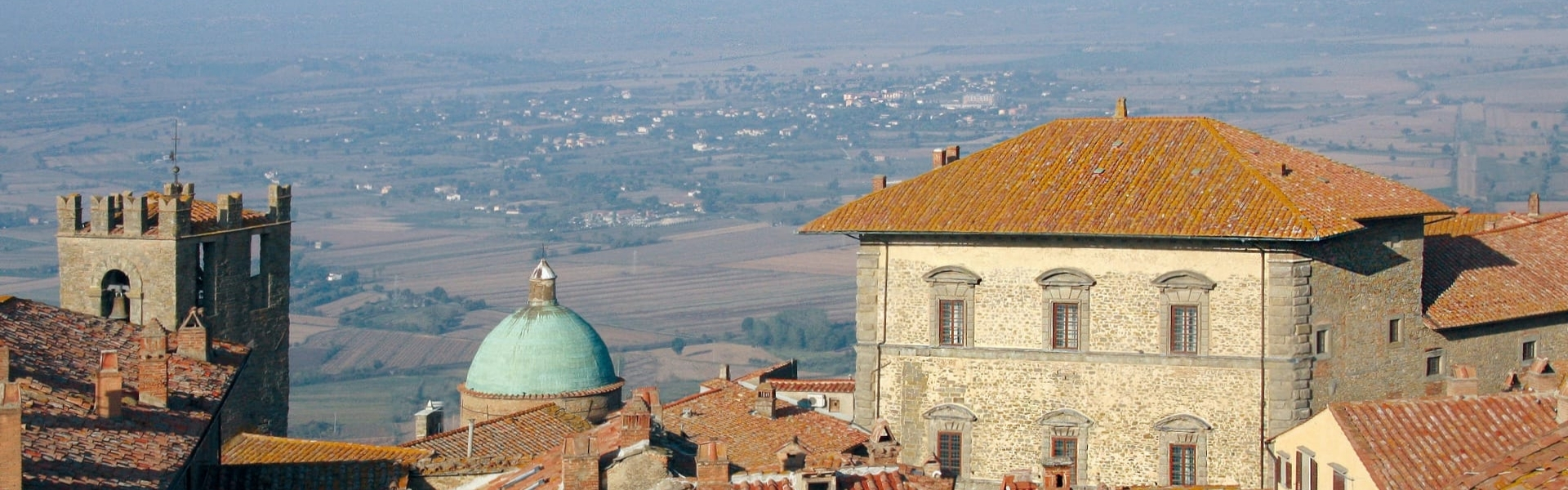
In the heart of Cortona, overlooking Piazza Signorelli, Palazzo Casali has been home to the Accademia Etrusca for almost three centuries.
The history of the building, however, stretches much further back. Once a noble residence, later the seat of the city government and eventually a centre for culture and research, Palazzo Casali has witnessed centuries of change in Cortona and still preserves many traces of the city’s history.
From the Casali Lordship to Florentine Rule
The origins of the palace date back to the thirteenth century. Closely associated with the Casali family, it became their official residence during their rule over Cortona, between 1325 and 1409. When Cortona came under Florentine rule, the building took on a new role. From 1411, it became the seat of the captains and, later, of the commissioners appointed by the Florentine government.
A particularly striking reminder of this long period survives today in the numerous stone coats of arms left by representatives of the Florentine government, visible on the exterior of the palace and on the walls of its inner courtyard.
Over the centuries, the building served many different purposes and underwent several alterations and extensions. Major changes were made during the seventeenth century, helping to shape the appearance it retains today as one of the most imposing buildings in Cortona’s historic centre and one of the city’s landmarks.
1727 | A Home for the New Accademia
The history of Palazzo Casali has been closely intertwined with that of the Accademia Etrusca since its foundation. When the Accademia was established in 1727, Grand Duke of Tuscany Gian Gastone de’ Medici granted it several rooms on the top floor of the palace.
A contemporary account describes the rooms made available to the Accademia as a space that, although intended for the city’s Commissioner, was no longer inhabited and had been left exposed to “the inclemency of the seasons”. Considerable work was therefore needed to make the rooms suitable for use. Yet it was from these seemingly unlikely surroundings for a new cultural institution that a story spanning centuries began.
Restoration and adaptation soon made it possible to house the collections donated to the Accademia by Onofrio Baldelli and to establish the Accademia’s Museum and Library, created alongside the institution itself as essential tools for study and the dissemination of knowledge.
In Search of New Spaces
As the Accademia’s collections and activities expanded, so too did the spaces available to it. For many years, the Museum and Library shared the rooms on the top floor. It was only in 1928, with the acquisition of additional rooms, that the two collections could be more clearly separated.
After the Second World War, the restoration of further areas of the palace allowed the Museum to expand once again, while the Library developed into a modern section alongside the valuable historic collection preserved in its original rooms.
The histories of the Accademia and Palazzo Casali have therefore continued to develop side by side: as the library and museum collections grew, along with research activities and conservation needs, the spaces within the palace were transformed and adapted to new uses.
2005 | The Birth of the MAEC
The extensive archaeological excavations carried out during the 1990s, both within Cortona and in the surrounding area, brought to light an important body of archaeological finds. The decision to keep all the finds in Cortona, supported by the presence of an established museum, created the need for additional exhibition space. New galleries were therefore created on the ground floor and in the lower levels of Palazzo Casali.
In 2005, the Museo dell’Accademia Etrusca became the MAEC, Museo dell’Accademia Etrusca e della Città di Cortona, doubling its exhibition space and introducing new displays and visitor facilities. Since then, relationships with major European museums have also intensified through a series of international exhibitions, helping to strengthen the presence of Cortona and the Accademia within the international cultural landscape.
Palazzo Casali Today
Today, Palazzo Casali is one of Cortona’s main cultural centres.
The building houses the MAEC, Museo dell’Accademia Etrusca e della Città di Cortona, where the Accademia’s historic collections are presented alongside archaeological finds from the city and its surrounding area.
Palazzo Casali is also home to the Library of the Municipality and the Accademia Etrusca and the Municipal Historical Archive, as well as the Accademia’s offices and other spaces. Museum, Library, Archive and Accademia thus coexist within the same building, making Palazzo Casali not only an extraordinary witness to the history of Cortona, but a living place where heritage preservation, research and the sharing of knowledge continue to come together.
From the medieval residence of Cortona’s lords to the home of the Accademia Etrusca, Palazzo Casali tells more than seven centuries of the city’s history and continues today to preserve and make accessible to the community a fundamental part of its heritage.
Read more
Mission and Motto
The motto of the Accademia Etrusca: from the words of Lucretius to its emblem, symbols of research, knowledge and cultural heritage preservation.
History
Three centuries of research, collecting and culture: explore the history of the Accademia Etrusca, from its 18th-century origins to the present day.
Palazzo Casali
Discover Palazzo Casali, home to the Accademia Etrusca: seven centuries of history, from the rule of the Casali family to the opening of the MAEC in 2005.