Obscura de re lucida pango
From its very beginnings, the Accademia Etrusca has expressed its vocation in just a few words:
OBSCURA DE RE LUCIDA PANGO
The motto expresses the idea of bringing clarity to what is obscure through study, research and knowledge.
The Words of Lucretius
The motto is taken from Book I of Lucretius’ De rerum natura (lines 921–950), in which the poet reflects on the challenge of addressing complex subjects and the need to make them accessible through the charm of the Muses.
[…] primum quod magnis doceo de rebus et artis
religionum animum nodis exsoluere pergo,
deinde quod obscura de re tam lucida pango
carmina, musaeo contingens cuncta lepore. […]
“[…] first, because I teach of great matters and strive to free the mind from the constricting bonds of religion; and then because, on an obscure subject, I compose verses filled with light, touching everything with the charm of the Muses. […]”
In Lucretius’ text, it is the Muses, through the power and appeal of poetry, who make it possible to explore and communicate difficult and complex subjects.
The Accademia adopted this image as a statement of purpose: to investigate, interpret and bring to light what time, history and antiquity have made difficult to understand.
It is a principle that has guided the institution since the eighteenth century and remains just as relevant today.
Understanding, Preserving, Sharing
Founded in 1727 as a place for study, intellectual exchange and the circulation of knowledge, the Accademia Etrusca has continued to embrace the vocation expressed in its motto: to study and interpret the past, preserve the heritage entrusted to it over the course of its history, promote research and make its results accessible.
Collaboration with scholars, universities and cultural institutions, the preservation of its collections, its publishing activities and the new opportunities offered by digital technologies continue today, through contemporary forms of communication, a mission begun almost three centuries ago: turning research into shared knowledge.
The Emblem of the Accademia
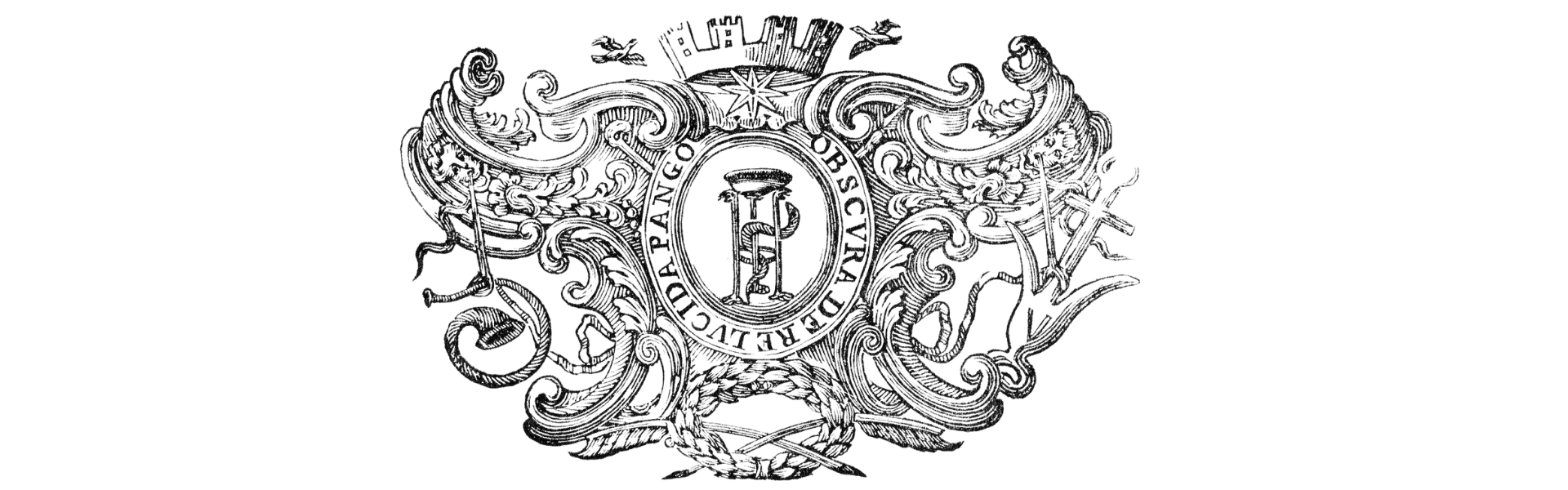
The same ideal takes visual form in the emblem of the Accademia Etrusca, in which each element carries a specific symbolic meaning.
The tripod, an attribute of Apollo associated with the Delphic oracle, evokes the possibility of finding answers even to the most obscure questions.
The serpent represents the wisdom that inspires and guides the pursuit of knowledge.
The star refers to Electra, the mythical daughter of Atlas and, according to tradition, the wife of Corythus, founder and king of Cortona.
Finally, the mural crown evokes the Accademia’s deep connection with Cortona, the city in which the institution was founded and where it continues to have its home.
Around the emblem runs the motto: Obscura de re lucida pango.
Words that connect the symbol of the Accademia with its very reason for being.
Read more
Mission and Motto
The motto of the Accademia Etrusca: from the words of Lucretius to its emblem, symbols of research, knowledge and cultural heritage preservation.
History
Three centuries of research, collecting and culture: explore the history of the Accademia Etrusca, from its 18th-century origins to the present day.
Palazzo Casali
Discover Palazzo Casali, home to the Accademia Etrusca: seven centuries of history, from the rule of the Casali family to the opening of the MAEC in 2005.